

VA Loan Blog

Is the Market Headed towards 3-D Printed Homes?


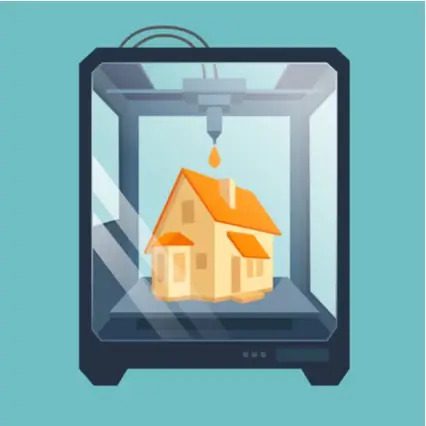
Having revolutionized everything from the auto industry to healthcare tech to the airline business, 3-D printing is poised to dramatically change the American housing market.

Lennar Corp., one of the largest U.S. homebuilders, has teamed up with Texas startup Icon to create an entire development near Austin with 100 3-D printed homes. This mass-scale project, set to begin in 2022, will be a test of the new technology’s ability to produce quality houses in bulk quantity.

“We’re sort of graduating from singles and dozens of homes to hundreds of homes,” said Jason Ballard, Icon’s chief executive.

Today, almost all new single-family homes are constructed on-site, using traditional building methods and wood framing.  However, a shift in labor choices over the past decade has pushed builders to consider more innovative options.

“Skilled tradesmen are a dying breed,” said Eric Feder, president of LenX, Lennar’s venture-capital and innovation unit. “So there have to be alternative building solutions to help with this labor deficit.”

For printing a home’s wall system, Icon only requires three on-site workers, compared to the six to 12 framers and drywall installers involved in a conventional build.

And instead of lumber, the 3-D printed houses from Icon use concrete, squeezed out in layers into molds, allowing for even curved walls and other designs often considered too complex and expensive to build. 

While it takes Icon roughly the same amount of time to print a 2,00-square-foot home’s interior and exterior wall system as it does to frame it with traditional methods, the company hopes to speed up the process as it gains more experience. 

That would spell great news for the current housing market where housing demand has far outstripped available inventory for over a year. 

And theoretically prices could come down eventually as well. Using less waste and fewer materials, 3-D printed homes can be made cheaper than typical houses.

However, Lennar has not determined its pricing for the near-Austin development, and buyers are not likely to see a large discount from the average surrounding prices at this point. The builder will be completing the homes with traditional construction methods, which will add to the labor and material costs.

Icon has a proven track record of producing fully-functional 3-D homes, having built 10 two-bedroom homes in Tabasco, Mexico and seven one-bedroom tiny homes and four two-story single-family residences in Austin. 

It remains to be seen, though, if consumers across the country will welcome the concept and look of 3-D printed homes. For example, because of the layered printing technique, Icon’s exterior wall and some interior ones include horizontal ridges that are not part of traditional homes.

And as a new, less-tested construction method, it is unclear if mortgage lenders will require any different qualifications or terms on 3-D printed homes. 

Still, demand appears to be strong among early-adopters. Another 3-D construction company, Oakland, Calif.-based Mighty Buildings already has a long wait list for its 15-lot community slated to break ground in southern California next year. 

Only time will tell if our American landscapes of Brownstones, Cape Cods and Craftsman homes will soon be replaced with these space-age technology dwellings.


Merry Christmas and Happy New Year


It's the most wonderful time of the year!

All of us at T&G Financial Inc. DBA Cornerstone Home Mortgage & West Coast Veterans would like to wish you a Merry Christmas and a Happy New Year!

We hope that 2022 is a year full of happiness, health and prosperity for you and your loved ones.

All the Best,
T&G Financial Inc. DBA Cornerstone Home Mortgage & West Coast Veterans

What Are Mortgage Origination Fees?


As a first-time homebuyer, there may be many mortgage terms that sound foreign to you. For example, when you start looking at interest rates offered by lenders, they will often be accompanied by a number of “points” or “origination fees.” What are these extra fees and do you have to pay them? 

Mortgage Origination Fees Defined

These are the lender’s costs for creating and processing (or originating) your mortgage loan. In addition to closing costs and interest rates, these fees are one of the ways lenders make their money. They include things like document preparation fees, processing fees, underwriting fees, tax service processing fees, and courier fees.

How Much Do They Cost?

Origination fees, or points as they are commonly called, can vary from lender to lender. You can expect to pay anywhere from 0.5% to 1% of the total loan amount. Say you are taking out a mortgage for $300,000. If your lender charges 1% in points, you will need to pay $3,000. 

In many cases, it is possible to “Buy down” your interest rate by paying more in origination fees. On average for every 1-point you pay, the mortgage rate will be lowered by 0.25%. So, if you’re being offered an interest rate of 4%, by paying an extra point (in the example above that would be $3,000 more) you can lock in a rate of 3.75%. While this is a lot of money up front, it could end up saving you much more over the course of the loan.

When Are Points Paid?

You expect to pay the origination fees when your loan closes. This is also when you will make your down payment and pay for other closing costs. The payment is typically made via cashier’s check or wire transfer, but other secure methods can be used as well. You will be notified at least three days before closing of the final total and breakdown of all the closing costs and fees. 

Do I have to Pay Origination Fees?

The short answer is yes, in some form or another. Even if your lender does not charge points, they still need to recoup their costs somehow. That will likely be through a higher interest rate or closing costs, so your total costs will be the same or perhaps more if you don’t pay points. This might be an acceptable situation for you if you don’t have much cash to get started and you plan to refinance down the road. Points can also be rolled into the mortgage balance, which means you wouldn’t pay cash out of pocket but it would slightly increase your monthly mortgage payment.

Can I Negotiate the Points?

You can definitely try to negotiate all or part of your lender origination fees but doing so could result in a slightly higher interest rate.

As you begin the home-buying process, understanding mortgage points will help you know how much mortgage you can truly afford and help you have enough cash on hand when you find the perfect property.